Here and Now
Paula Drew on Child Care Bridge Payments Ending in Wisconsin
Clip: Season 2400 Episode 2447 | 6m 7sVideo has Closed Captions
Paula Drew on anticipated impacts of the expiration of Child Care Bridge Payments.
Wisconsin Early Childhood Association Director of Policy and Research Paula Drew discusses anticipated impacts of the expiration of Child Care Bridge Payments made by the state to support providers.
Problems playing video? | Closed Captioning Feedback
Problems playing video? | Closed Captioning Feedback
Here and Now is a local public television program presented by PBS Wisconsin
Here and Now
Paula Drew on Child Care Bridge Payments Ending in Wisconsin
Clip: Season 2400 Episode 2447 | 6m 7sVideo has Closed Captions
Wisconsin Early Childhood Association Director of Policy and Research Paula Drew discusses anticipated impacts of the expiration of Child Care Bridge Payments made by the state to support providers.
Problems playing video? | Closed Captioning Feedback
How to Watch Here and Now
Here and Now is available to stream on pbs.org and the free PBS App, available on iPhone, Apple TV, Android TV, Android smartphones, Amazon Fire TV, Amazon Fire Tablet, Roku, Samsung Smart TV, LG TV, and Vizio.
Providing Support for PBS.org
Learn Moreabout PBS online sponsorshipfrom Portage.
I'm Steven Potter for "Here& Now".
>> If you have children and child care programs, expect tuition to go up and availability to go down.
That's because temporary Covid era funding to help providers keep costs down and retain staff is set to expire at the end of June.
The child care bridge payments of $110 million took up after more robust federal stabilization funding ended results from a new report and survey from the Wisconsin Early Childhood Association show that three quarters of providers across the state said they'll need to raise tuition, and a quarter of providers said they're likely to close.
We're joined now by Paula Drew, director of early childhood education policy and research for the association, and thanks very much for being here.
>> Thanks for having me.
>> So with costs up elsewhere for food and fuel, how are working families who depend on childcare likely to respond to these tuition hikes?
>> I think families around the state right now are sitting around tables like this, asking themselves, does it make sense for one of us to keep working?
If it makes sense, should we work part time instead of sending our child to a licensed child care program down the street?
Perhaps we should entertain a grandparent, a neighbor, because the cost of care is just becoming unaffordable to the point where those who have the means to access it will, and those that don't simply will be sort of priced out of the market.
>> Because what kind of tuition increases could we be talking about in general?
>> So 75% of child care providers at answer this question, and they said, we will have to raise our tuition rates at least $25 per week.
And so that's, you know, between 2000 and $3000 per year.
>> It's already pretty expensive.
>> It's already, I think, at the point where some families can no longer afford it.
>> So how meaningful was the original "Child Care Counts" program that used federal emergency Covid funds to stabilize the industry?
>> The original "Child Care Counts" program was very meaningful, and child care providers have been on record over and over and over, stating, this is the first time I've ever been able to start a retirement account.
For our early educators, we are actually accessing health insurance for the very first time.
Our early educators are earning a wage in which they only have to work one job.
It also kept tuition rates affordable for parents.
>> How much of Wisconsin providers gotten from both programs?
>> Hundreds of millions of dollars.
>> And so going from hundreds of millions of dollars over the past six years to nothing, it's easy to see why your survey results show that they will have to make some of these very difficult choices.
>> That's right.
For years on end, childcare providers have been depending on this funding to meet the gap between what parents can pay and what it actually costs to provide high quality childcare.
And without those funds, most people within the field are asking these same, very hard questions that parents are should we close?
Should we let go of some staff?
Should we lessen the hours of operations that we have, stop providing food, stop providing bussing, you know, cutting costs, right?
Both parents and providers are are trying to figure out how they can make the math work.
is my understanding is that it's already difficult, but how stunning is it that a quarter of providers might have to close their operations?
>> It's very dramatic.
And I think when we dig into the numbers and we think about 25% of providers now, 25% of group providers, that's a really significant amount of child care seats available in the state.
Right?
So family child care providers can serve up to eight children at a time, but group programs can serve hundreds of children.
So we're thinking about, you know, when you just think 25%, it's not just like across the board in terms of how many seats we have.
And I think that's going to be really stark.
And I also would estimate that that that number is likely going to be larger than it was when the research was done.
>> Is there any prospect that the state would replicate this funding?
>> I would love to see this program be codified into law.
I think we have seen examples from all over the country states, red, blue, purple states making significant investments in the childcare sector and seeing really big returns on that investment.
Anything's possible when you prioritize it.
And yes, we would love to see this program continue it.
It had all the components that I think are needed to hold together.
This market.
>> Is, for some policymakers, does that kind of funding smack of an entitlement?
>> It can and I think it it's because the childcare sector itself is is made up of for profit, nonprofit family child care providers operating out of their homes, you know, large group programs.
It's hard to sort of wrap your mind around it versus like a K-12 system.
You need a teaching license, you need a certain amount of education to meet the teaching license.
That doesn't mean that that's not also required in early care and education, but it's not what you think about because of the the fabric of these providers in the state, you know, look different.
But I would argue a, you know, a wage and career ladder for early care and education based on experience.
And their own education is the same.
That is in K-12 schools, right?
In which is public is publicly funded.
We see that as a public good.
What's happening over here is the same exact thing, but it's entirely funded
 New
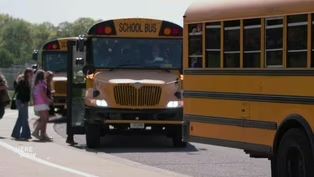
NewThe Continuing Closure of Rural Schools Around Wisconsin
Video has Closed Captions
Clip: S2400 Ep2447 | 7m 44s | Rural school districts face decisions over closing facilities or shutting down altogether. (7m 44s)
 New
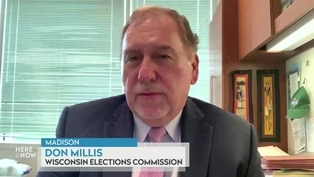
NewDon Millis on Administering Wisconsin's Elections in 2026
Video has Closed Captions
Clip: S2400 Ep2447 | 5m 51s | Don Millis on a FBI probe into the 2020 vote and a proposed new mail-in ballot rule. (5m 51s)
 New
NewHere & Now opening for June 5, 2026
Video has Closed Captions
Clip: S2400 Ep2447 | 1m 7s | The introduction to the June 5, 2026 episode of Here & Now. (1m 7s)
 New
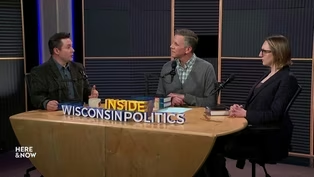
NewInside Wisconsin Politics: Trump's Chippewa County Visit
Video has Closed Captions
Clip: S2400 Ep2447 | 2m 24s | Inside Wisconsin Politics on President Trump's visit to Chippewa County. (2m 24s)
 New
NewTrump Visits Wisconsin to Tout His Agriculture Tax Breaks
Video has Closed Captions
Clip: S2400 Ep2447 | 2m 44s | President Donald Trump visited Chippewa County to promote his agricultural policies. (2m 44s)
Providing Support for PBS.org
Learn Moreabout PBS online sponsorship New Episode
- News and Public Affairs

Top journalists deliver compelling original analysis of the hour's headlines.

- News and Public Affairs

FRONTLINE is investigative journalism that questions, explains and changes our world.
 New Episode
 New Episode
 New Episode


 New Episode
 New Episode
 New Episode
Support for PBS provided by:
Here and Now is a local public television program presented by PBS Wisconsin