
Unpacking the meaning behind Mary Oliver's "Wild Geese"
Clip: 8/25/2026 | 2m 31sVideo has Closed Captions
"Wild Geese" is one of Mary Oliver's most popular poems.
"Wild Geese" is one of Mary Oliver's most popular poems. Poet David Keplinger, musician Lucy Dacus, and comedian Stephen Colbert share what the poem means to them. "We think of wild as chaotic, but wild is harmonious with the wilderness, which is where we all came from," said Colbert. "We're born wild."
Problems playing video? | Closed Captioning Feedback
Problems playing video? | Closed Captioning Feedback
Support for American Masters is provided by AARP, The Rosalind P. Walter Foundation, Thea Petschek Iervolino Foundation, Burton P. and Judith B. Resnick Foundation, The Philip and Janice Levin Foundation,...
Support provided by:

Unpacking the meaning behind Mary Oliver's "Wild Geese"
Clip: 8/25/2026 | 2m 31sVideo has Closed Captions
"Wild Geese" is one of Mary Oliver's most popular poems. Poet David Keplinger, musician Lucy Dacus, and comedian Stephen Colbert share what the poem means to them. "We think of wild as chaotic, but wild is harmonious with the wilderness, which is where we all came from," said Colbert. "We're born wild."
Problems playing video? | Closed Captioning Feedback
Where to Watch American Masters
American Masters is available to stream on pbs.org and the PBS app.
Buy Now
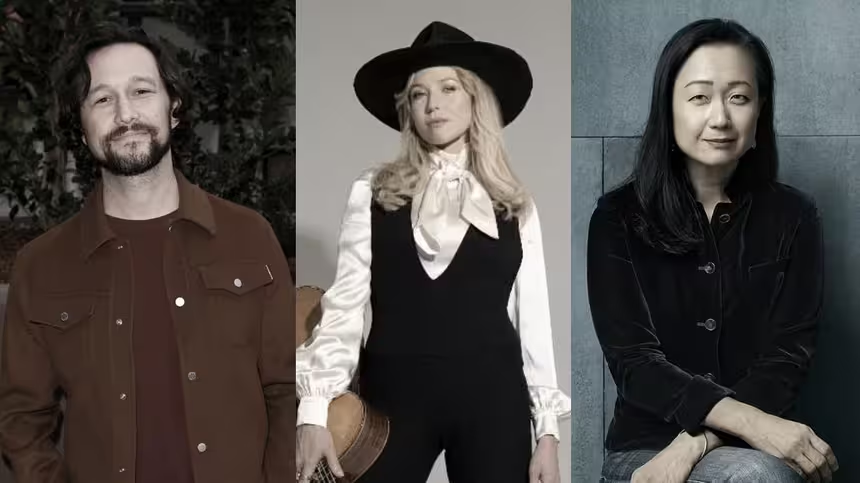
A front row seat to the creative process
How do today’s masters create their art? Each episode an artist reveals how they brought their creative work to life. Hear from artists across disciplines, like actor Joseph Gordon-Levitt, singer-songwriter Jewel, author Min Jin Lee, and more on our podcast "American Masters: Creative Spark."Providing Support for PBS.org
Learn Moreabout PBS online sponsorship- As I was leaving, she kind of blew kisses and said, "I love you and goodbye."
But the last thing that she said was, "No moping.
No moping."
To me, you could look at every poem that she's written and say, "Is the underlying message here no moping?"
"Meanwhile, the world goes on."
"Meanwhile, everything is happening."
"Meanwhile, the wild geese."
- [Mary] You do not have to be good.
You do not have to walk on your knees for a hundred miles through the desert repenting.
You only have to let the soft animal of your body love what it loves.
Tell me about despair, yours, and I will tell you mine.
Meanwhile, the world goes on.
Meanwhile, the sun and the clear pebbles of the rain are moving across the landscapes, over the prairies and the deep trees, the mountains and the rivers.
Meanwhile, the wild geese high in the clean blue air are heading home again.
Whoever you are, no matter how lonely, the world offers itself to your imagination, calls to you like the wild geese, harsh and exciting, over and over announcing your place in the family of things.
- You can read it a hundred times and hear it differently every time.
Who is the you, and what does good even mean?
- It's a wild goose.
It's the wild geese.
We think of wild as chaotic, but wild is harmonious with the wilderness, which is where we all came from.
We're born wild.
- I think people feel a lot of pressure to be good by external metrics.
One of the things she learned by being dedicated to nature was that that question doesn't follow deer and it doesn't follow bees.
Why are we putting this on ourselves?
(cheerful music)
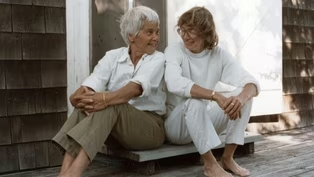
How Mary Oliver met her life partner, Molly Malone Cook
Video has Closed Captions
Mary Oliver met her life partner, photographer Molly Malone Cook, at Steepletop. (1m 27s)
Mary Oliver had a troubled childhood
Video has Closed Captions
Mary Oliver often hinted at the turmoil within her family, but sought to move past it. (2m 33s)
Mary Oliver: Saved by the Beauty of the World
Video has Closed Captions
Celebrate the life and career of Pulitzer Prize-winning poet Mary Oliver. (2m 37s)
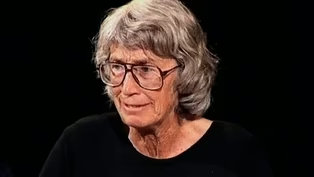
The political nature of Mary Oliver's poems
Video has Closed Captions
Mary Oliver sought to call attention to the destruction of the earth in her work. (2m 1s)
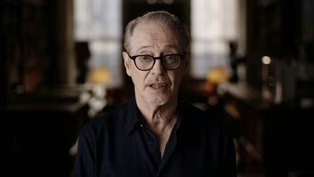
Steve Buscemi reads Mary Oliver's poem, "The Fish"
Video has Closed Captions
Listen to Steve Buscemi read Mary Oliver's poem "The Fish" in this excerpt from the film. (1m 19s)
Providing Support for PBS.org
Learn Moreabout PBS online sponsorship









Support for PBS provided by:
Support for American Masters is provided by AARP, The Rosalind P. Walter Foundation, Thea Petschek Iervolino Foundation, Burton P. and Judith B. Resnick Foundation, The Philip and Janice Levin Foundation,...