
How Iran is reacting as Trump pulls back from threats
Clip: 4/7/2026 | 4m 17sVideo has Closed Captions
How Iran is reacting as Trump pulls back from threat to wipe out civilization
President Trump made a violent and extraordinary threat on Tuesday, saying he would erase an entire civilization if Iran didn't agree to his terms for a deal. He backed down from that rhetoric later in the day, agreeing to a two-week ceasefire. To discuss the reaction in Iran, Geoff Bennett spoke with special correspondent Reza Sayah in Tehran.
Problems playing video? | Closed Captioning Feedback
Problems playing video? | Closed Captioning Feedback
Major corporate funding for the PBS News Hour is provided by BDO, BNSF, Consumer Cellular, American Cruise Lines, and Raymond James. Funding for the PBS NewsHour Weekend is provided by...
How Iran is reacting as Trump pulls back from threats
Clip: 4/7/2026 | 4m 17sVideo has Closed Captions
President Trump made a violent and extraordinary threat on Tuesday, saying he would erase an entire civilization if Iran didn't agree to his terms for a deal. He backed down from that rhetoric later in the day, agreeing to a two-week ceasefire. To discuss the reaction in Iran, Geoff Bennett spoke with special correspondent Reza Sayah in Tehran.
Problems playing video? | Closed Captioning Feedback
How to Watch PBS News Hour
PBS News Hour is available to stream on pbs.org and the free PBS App, available on iPhone, Apple TV, Android TV, Android smartphones, Amazon Fire TV, Amazon Fire Tablet, Roku, Samsung Smart TV, and Vizio.
Providing Support for PBS.org
Learn Moreabout PBS online sponsorshipGEOFF BENNETT: Let's shift our focus now to Tehran and special correspondent Reza Sayah, who's been following this precarious back-and-forth from the Iranian capital.
So, Reza, the news of a two-week cease-fire just came.
Have you heard any reaction yet?
REZA SAYAH: Yes, no official reaction from government officials, other than that they have accepted this proposal.
But I think, publicly, they're going to pour trade as a victory against the United States and Israel.
Just like Mr.
Trump on Monday and his secretary of war portrayed the recovery of the U.S.
fighter pilot as a huge victory and a show of U.S.
military might, I think Iran is going to portray disagreement as a win.
Remember, for Iran, survival was always victory.
And despite taking many losses, the destruction of military hardware, the destruction of industrial and economic infrastructure, the assassination of political military leaders, the loss of their supreme leader, they are still standing.
And, for them, this is a win.
And state media is reporting it as such.
I'm going to read you a couple of headlines that were just published a couple of minutes ago.
Fars News Agency writing "Trump Once Again Retreating."
Mehr News headline is "The Strength and Resistance of Iran Forced Trump to Accept a Cease-Fire."
So, certainly they're presenting it as a win.
But I think, moving forward, all eyes are going to be on the Strait of Hormuz.
The agreement says Iran must open it, and we will see if they open it and what they do beyond the two weeks.
GEOFF BENNETT: It's striking to hear you say that, for Iran, survival is victory.
How then did Iranian officials react to President Trump's threat earlier today to erase an entire civilization in Iran, as he threatened?
REZA SAYAH: Yes, I think the people who reacted negatively.
They were very concerned about what he meant.
When you have the leader of the free world, the president of the strongest country in the world threatening to erase your civilization, you wonder what he means.
The military leaders were more dismissive.
Their position is, if he's going to attack our infrastructure, we're going to do the same.
But I think that rhetoric is behind us right now.
And moving forward, we're going to see how this plays out and especially beyond these two weeks.
Remember, it was increasingly clear that Iran's hold of the Strait of Hormuz was a lever they never had before until this war, a lever with which they could wage war on the global economy in response to U.S.
and Israeli bombings and in many ways guarantee their security.
And I think it'll be very interesting to see two weeks from now.
This was their demand to keep a hold of the Strait of Hormuz, to change the protocol.
Will they stand firm next to that demand or forgo it?
That's going to be key moving forward.
GEOFF BENNETT: And, Reza Sayah, finally, do Iranians, based on your reporting and based on your conversations, do they think that this will lead to a lasting peace?
REZA SAYAH: I think it's too early.
I think my impression is, most Iranians are going to be relieved that seven weeks of being bombed is over, that they can take a breath, that they can rest.
But, in the past 47 years, they haven't been able to rest much.
It's been 47 years where they have faced a brutal government and pressure, sanctions, and two wars, facing the United States and Israel.
So I think they're going to be able to take a breath, exhale for a couple of weeks, and we will see what unfolds after this two-week cease-fire and if the peace is sustained or we're back to conflict and hostilities.
GEOFF BENNETT: Reza Sayah joining us tonight from Tehran.
Reza, our thanks to you.
 New
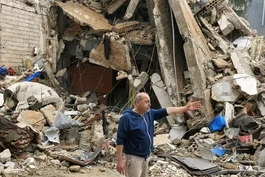
NewCivilians caught in path of Israeli invasion in southern Lebanon
Video has Closed Captions
Civilians caught in path of Israeli invasion in Lebanon (7m 57s)
 New
NewEstrogen patches face shortage as more seek hormone therapy
Video has Closed Captions
Estrogen patches face shortage as more women seek hormone therapy (9m 34s)
 New
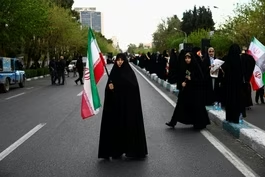
NewMideast experts weigh Iran's leverage in U.S. negotiations
Video has Closed Captions
Mideast experts weigh Iran regime’s leverage in negotiations with U.S. (8m 46s)
 New
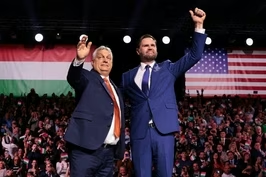
NewNews Wrap: Vance backs Orbán in visit ahead of election
Video has Closed Captions
News Wrap: Vance backs Orbán in visit ahead of Hungarian elections (5m 32s)
 New
NewPatrick Radden Keefe joins Amna Nawaz on 'Settle In'
Video has Closed Captions
On 'Settle In,' Patrick Radden Keefe and Amna Nawaz discuss 'London Falling' (3m 38s)
 New
NewTBIs become defining injury for U.S. troops post-9/11
Video has Closed Captions
Traumatic brain injuries become defining injury for U.S. troops in post-9/11 conflicts (6m 52s)
 New
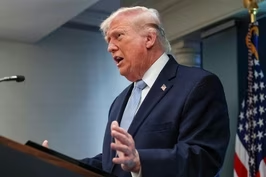
NewTrump backs down from threats to destroy Iran infrastructure
Video has Closed Captions
Trump agrees to 2-week ceasefire, backs down from threats to destroy Iran's infrastructure (5m 26s)
Providing Support for PBS.org
Learn Moreabout PBS online sponsorship
- News and Public Affairs

FRONTLINE is investigative journalism that questions, explains and changes our world.

- News and Public Affairs

Amanpour and Company features conversations with leaders and decision makers.












Support for PBS provided by:
Major corporate funding for the PBS News Hour is provided by BDO, BNSF, Consumer Cellular, American Cruise Lines, and Raymond James. Funding for the PBS NewsHour Weekend is provided by...